advice

This section brings together all the best practices from design to execution of efficient stainless steel bar stations. As every establishment has its own specifics, we share our knowledge and industry experience as bar designers and builders to help you better understand your project.

THE WATERPROOFING OF FLOORS AT THE BAR

- Categories : Best practices

Since the bar is a technical area with water inlets and outlets, this zone must consider waterproofing issues and the recommendations set by the DTU.

Unlike a professional kitchen, the bar area is not confined to a space where everything is designed to drain water. In a professional kitchen, everything is done to drain cleaning water into floor siphons with slopes preventing overflow and waterproofing treatments rising up the walls. The bar area is located in the operational room and must balance aesthetics and functionality with a highly complex fluid network. A leak accident is often much less costly in a kitchen than in a bar area, where the water will spread over expensive flooring materials, like parquet and carpets, which are complex to replace. This is why the design and construction supervision of a bar are often, in some aspects, more complex than those of a professional kitchen.

Water flowing in a professional bar sink

This sealing issue introduces a certain complexity in the design of the bar for three reasons:

- All seals have a minimum rise of 10 cm above the finished floor. This poses a major constraint for all equipment that needs to be installed with gravity drainage. The machine's drainage must therefore appear above the 10 cm of sealing + the necessary height of the plumbing drainage elbows + the necessary slope between the equipment and the positioning of the slope (count 2 cm per meter). This implies that by raising certain equipment, the height of the top of the work surface must also be raised.

- When fluid passage systems are separated from walls, partitions, posts, curbs, or any element, strict standards dictate their size and constraints.

- The area to be sealed also extends around the bar through the bar entrances. This area is referred to as the threshold. It is then necessary to seal at the distances recommended by the DTU.

However, after participating in numerous construction projects, we notice that few companies strictly adhere to these provisions. What is recommended in the DTU is often difficult to achieve in bar areas because the specificities of the equipment and the lack of space do not allow certain rules to be followed. This is the case, for example, with the distance between concrete pads and elevations, which in many establishments would simply prevent the possibility of installing the bar. Yet, given the risks and the rapid degradation of equipment due to usage, it is precisely in the technical areas of bars that these provisions must be respected.

The construction projects where all these standards and provisions are truly followed are those involving the construction or renovation of entire large-scale establishments. On these projects, control offices supervise the proper implementation, as given the financial costs, in the event of future issues, risks and responsibilities must be managed.

On most construction projects, the contractor and project managers prefer to follow the provisions while maintaining common sense, sometimes allowing them to choose a less restrictive solution in light of the risks.

Releases of expectations without concrete reinforcing bars as part of a bar layout.

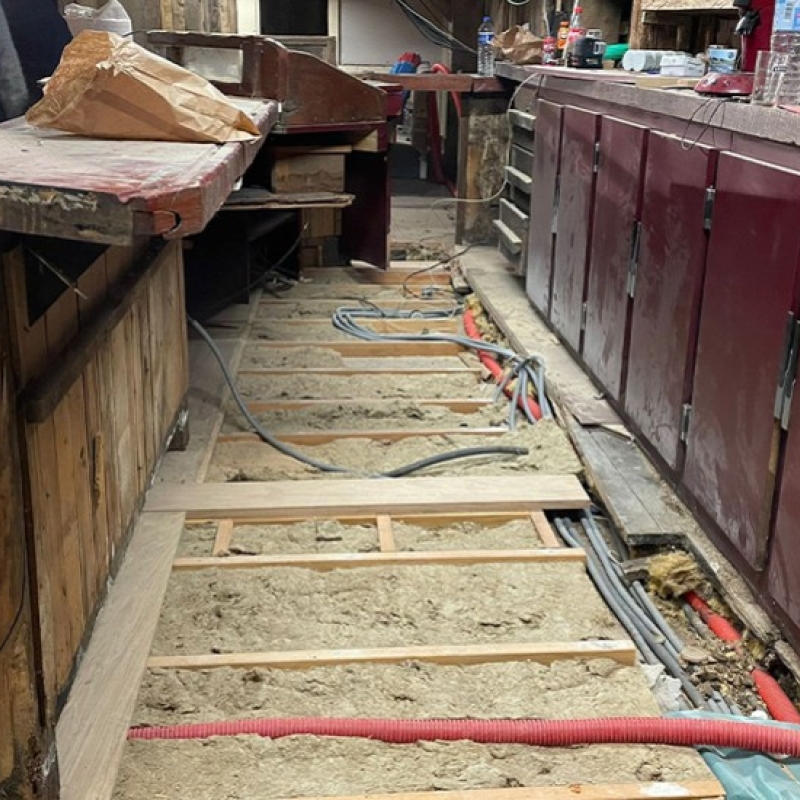
Surprising example: In this photo, you can see outlets without concrete bases. Very surprising, in case of a leak, water enters the reservation and follows along the pipes. When creating a hotel bar located on intermediate floors of a building, the client and their project manager assistant made the exceptional choice not to want waterproofing at the bar, confining the water to the bar floor. In case of a leak at the bar, the water flowing along the networks would deteriorate the offices located below. The client financially assessed that it was more advantageous to carry out repairs on the offices than to lose days of restaurant operation and incur much more expensive repairs due to the noble materials and implementation in their restaurant.

Here, a concrete block emerges from the raw slab. The reinforcements arrive from the lower floor through coring. The missing concrete parts will be added. A concrete block along the entire length of the bar ensures the waterproofing of the entire area. A measurement can be taken on the interior part of the bar, ensuring waterproofing in compliance with the DTU. At the bar entrances, the waterproofing should extend by 1 meter. In this photo, you can see 3 reservations on the concrete block. These reservations allow the equipment installed in the bar, such as glass washers and standard refrigeration machines, to be set back as much as possible against the bar's facade. This allows for a gain of up to 10 cm along the entire length in the room. For a bar approximately 10 meters long, this results in a gain of 1m² of room space while preserving the bar's waterproofing.

Like any construction, the bar follows DTU standards. Therefore, it is necessary to refer to the interior floor waterproofing guidelines. The waterproofing can be built with a hydrocarbon product, meaning a concrete block is made and then sealed with a hydrocarbon resin. The issue of the bar's waterproofing lies in the positioning and sizing of the waterproofing blocks.

This first diagram represents the sizing of the blocks, the minimum distances between them, and the reliefs. This principle is directly dictated by NF DTU 43.6.

Diagram representing the sizing of the pads, the minimum distances between them, and the elevations as part of a bar layout

- A: The sides of the concrete block being less than 400 mm, it must be positioned at a minimum of 250 mm from a protrusion.

- B: The sides of the concrete pedestal being less than 400 mm, it must be positioned at a minimum of 250 mm from a protrusion. Furthermore, all concrete blocks with sides less than 400 mm must be separated by 250 mm.

- C: The sides of the concrete block being between 400 mm and 1200 mm must be separated by 500 mm from any protrusion or another concrete block.

- D: If the bar cladding is not a projection, then the concrete block can be adjacent to it, provided the waterproofing implementation rules are followed.

E: For any slab support structure following the principle of waterproofing blocks with sides greater than 1200 mm, it must be distanced by more than 1000 mm from any protrusion.

F: Same as A.

G: Same as B.

This diagram presents the simplest way to construct concrete blocks in the bar area. In the front-bar, it can be seen that the technical provisions lead directly into the technical reservation of the furniture. This technical reservation allows for the distribution of provisions throughout the bar. In the back-bar, the 10 cm rise of the waterproofing block necessitates opening onto areas without equipment. However, many bar appliances, such as ice machines, require a floor-level drain, so either the equipment must be raised or one must forego the traditional solution of concrete blocks.

This diagram presents a way to bypass the concrete blocks behind the bar by directly opening the fluid inlets and outlets into the slope. This avoids having a block in the middle of the furniture. In front of the bar, it is possible to create a much larger pedestal resembling a floor slab. This slab allows the bar to be placed. The advantage of this is that it prevents any waste from going under the furniture when using the bar. We consider this configuration to be a very good solution.

When there is limited space for network passage, which is often the case in small areas where one wishes to offer clients the maximum possible space, it is possible to install plates with metal sleeves. This allows for the elimination of 20 cm by 20 cm concrete blocks and replaces them with a tube footprint of 60 to 100 mm. To consider this system, the plate and sleeve must be made of stainless steel with a minimum thickness of 5 mm, and the bar furniture must be anchored to the floor to ensure they are not movable.

The diagram of the sealing treatment of the sleeve and the metal plate.

The choice of a solution is more often guided by technical constraints than by a purely free choice. It is important to take the time to choose the right solution in order to avoid any future disappointment.

You may also be interested in these other tips