The 6 Factors Modulating the Calibration of the Professional Bar
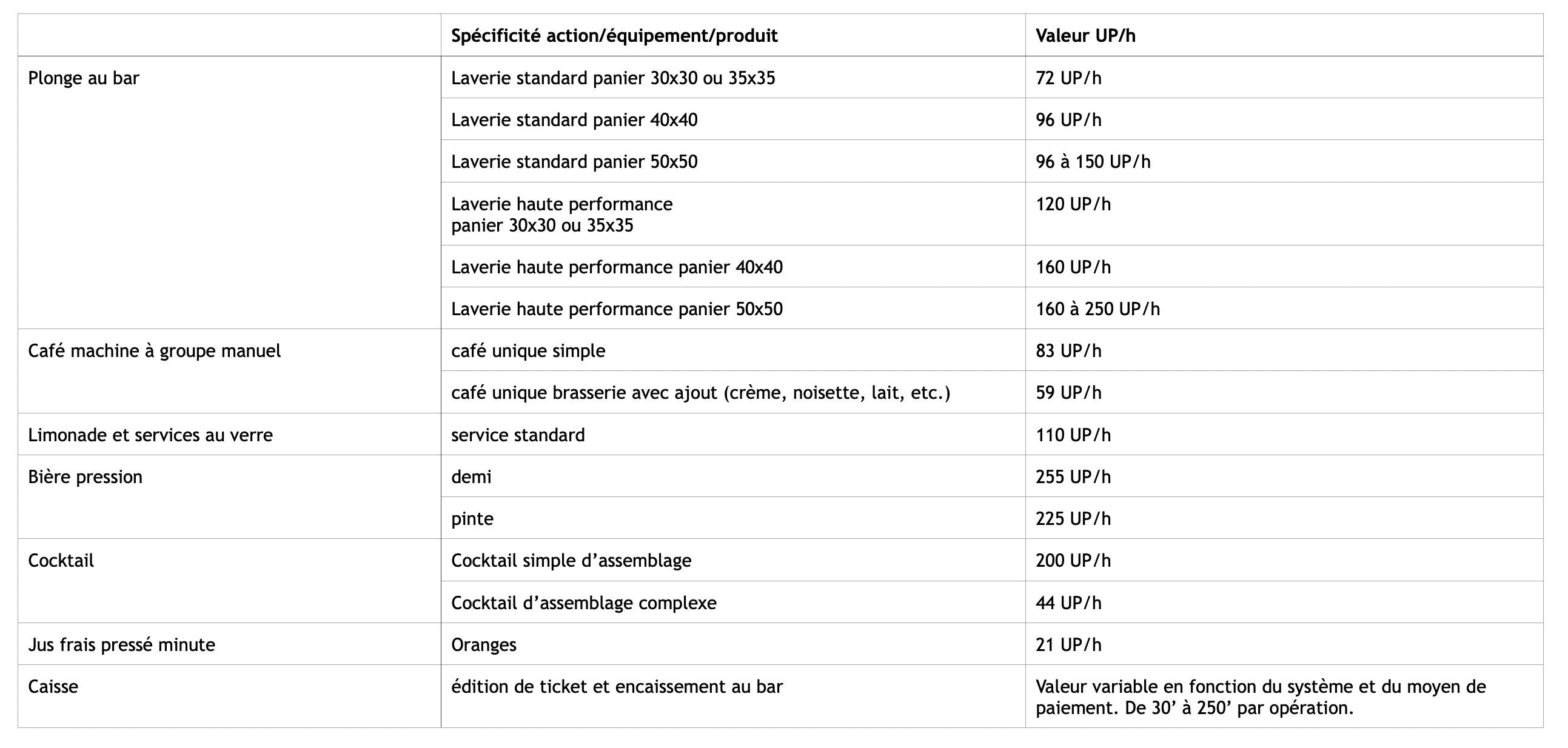
The values of UP/h (unit of production per hour) cannot be considered without a margin of tolerance. Six factors modulating this margin need to be taken into account:
- The staff and their skills.
- The stock and its volume and rotation capacity.
- Temporal variations in production.
- The space and organization of workstations.
- The quality and level of production complexity.
- The distribution of product orders by category.
The staff and their skills:
Depending on the skills of the staff and the speed of task execution, the values of the UP/h are modified. It is therefore essential to consider this parameter and adjust the UP/h to be as close as possible to the actual people working at the bar.
The stock and its volume and rotation capacity:
When calculating the UP/h, one must ensure that stock rotation is sufficient for real-time production.
Temporal variations in production:
The UP/h helps determine production units over a period of time. Since an establishment does not have the same production in terms of volume and variety depending on the time of day, day of the week, or season, it is beneficial to divide shifts into several time slots, which better manages production units.
The space and organization of workstations:
One must study any exception or organizational flaw in the space that reduces the UP/h values.
The quality of production:
Because sending out low-quality coffees and barista coffees or basic cocktails and mixologist cocktails does not require the same investment in skills, storage, setup, and preparation time, this has a significant influence on the UP/h.
The distribution of product orders by category:
It is known that the narrower the production menu is, meaning less diversity of production at the bar, the higher the UP/h values. Conversely, the wider the production range at the bar, the more the UP/h decreases because the complexity of production, organization of equipment, and space increases production times.