* Article CO 41
Accessory and Additional Exits
§ 1. Accessory exits may be required after consultation with the safety commission if, exceptionally, the regular exits and stairs cannot be judiciously distributed.
§ 2. Accessory exits can consist of exits, stairs, walkways, bridges, underground passages, or easy and safe circulation paths with a minimum width of 0.60 meters, or even continuous balconies, terraces, ladders, evacuation chutes, etc.
When an accessory exit crosses a property belonging to a third party, the operator must justify contractual agreements in the form of an authentic deed. If the exit passes through a partition wall with a building or room occupied by a third party, the doorway must be fire-rated for half an hour and equipped with a door closer.
Accessory stairs are not subject to the provisions of articles CO 36, 38, 50 (§ 3, 1st paragraph), 55, and 56.
§ 3. Additional exits are subject to the general provisions related to exits, except for those in articles CO 36 and 38.
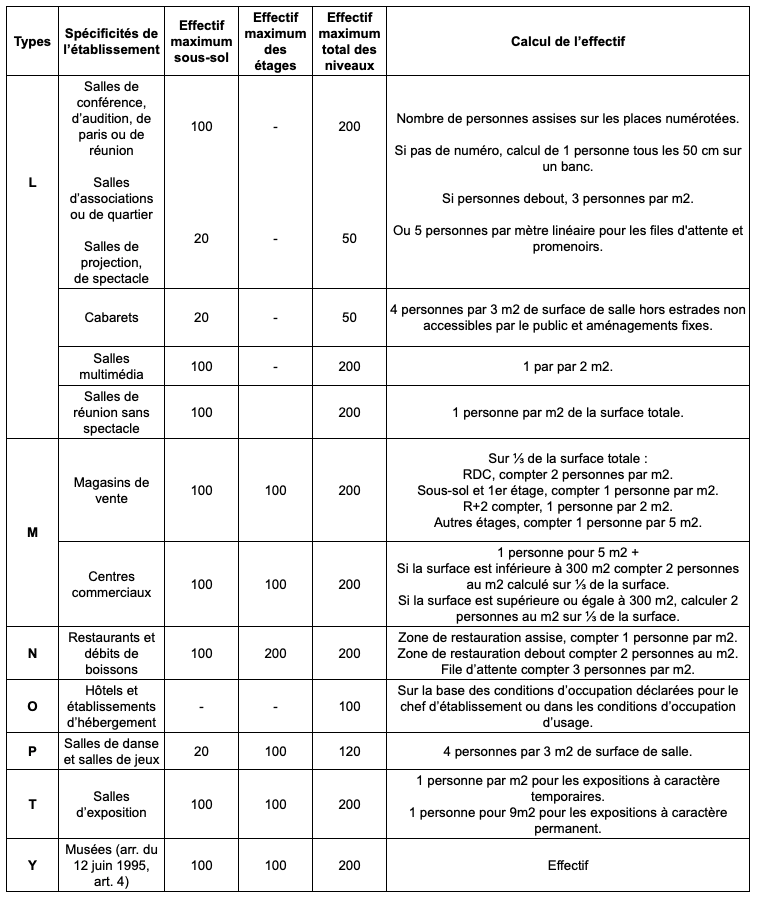
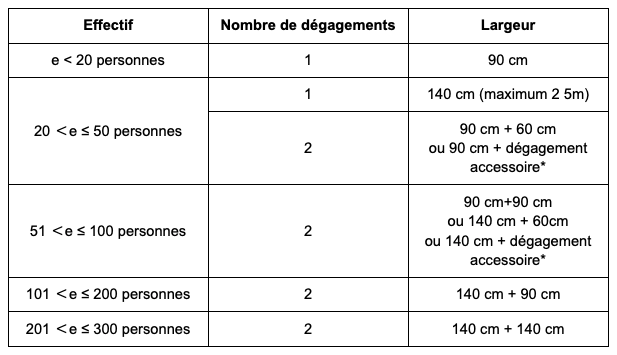
Example: Following the previous example, we calculated a maximum capacity of 65 people in the bar. According to the table, we fall into the range of 51 to 100 people. Therefore, the venue must offer either two exits of 90 cm or one exit of 140 cm and one exit of 60 cm, or one exit of 140 cm + accessory exit. In our example, the venue has a main door of 140 cm and a door connecting to the common areas of the building of 90 cm. The establishment thus complies with the initial fire safety rules.
This simple example does not take into account the multitude of characteristics and rules addressed in the regulations. Depending on the layout of the venue, the distances of the exits, the age of the building, the size of the levels, etc., multiple rules are imposed. To better inform oneself without delving into the complexity of regulatory texts, there are guides available to help understand and easily interpret these issues.