advice

This section brings together all the best practices from design to execution of efficient stainless steel bar stations. As every establishment has its own specifics, we share our knowledge and industry experience as bar designers and builders to help you better understand your project.

THE 3 OBJECTIVES OF A PROFESSIONAL BAR LAYOUT

- Categories : Best practices

1. Spatial and Furniture Optimization in Professional Bar Layout

A well-designed professional bar allows staff to work without unnecessary effort. The goal is to optimize the labor resource for normal bar production, and especially during peak hours, to achieve sustained productivity without overheating.

Economy and efficiency of movement are provided by a clear layout and ideal ergonomics of the spaces and tools available. Often mentioned are the bar's production triangle rule, the direction of movement, the respect for ergonomic shapes and dimensions of furniture, circulation, and comfortable lighting for the bartender.

A bartender working behind the bar, out of habit, often forgets that sources of physical difficulties are generally caused by design errors. These complex gestures become natural, and they even forget the presence of discomfort or difficulty, and thus the possibility for improvement, until musculoskeletal disorders (MSDs) appear or a functional error causing operational loss is identified.

For example, during an intervention in a large Parisian establishment, the return dishwashing area of a restaurant was always cluttered, forcing the dishwasher to quickly handle returns to avoid occasional breakages. A simple modification of the table and the position of glass racks and a return tray support solved a major problem that, unfortunately, had not been detected by the historic team.

Designing the organization of a professional bar involves thinking globally about "macro activity" across the entire service of the establishment and circulation. Then, imagine each activity terminal "micro activity," meaning the individual workstations.

Photo of an open professional bar with customers

2. The Macro Activity of the Bar: Analysis of General Movements

The starting point of the reflection lies in optimizing the operation of the bar. How can we make the most of the space based on the material and human resources we believe we can project into it? Without forgetting the customer experience we want to create? This is why we focus on managing flows and movements to improve production within the establishment.

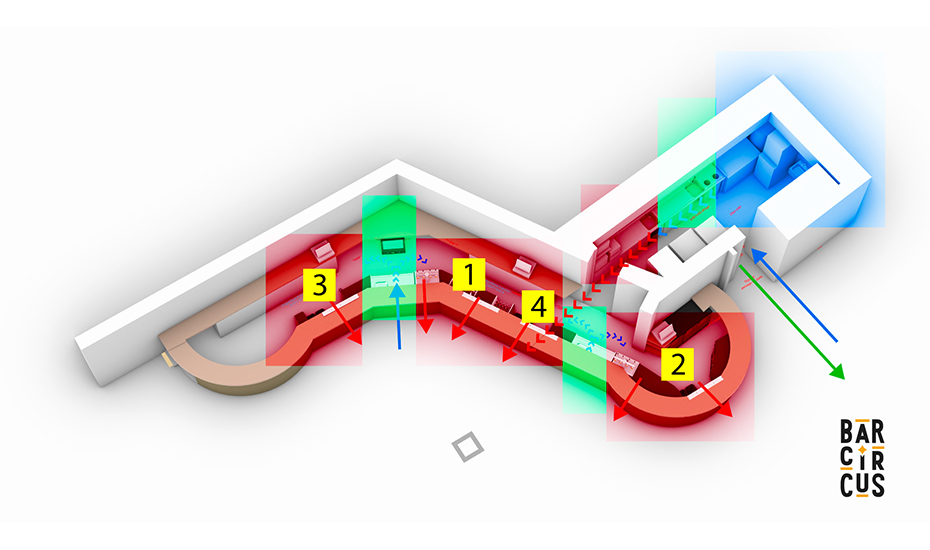
The macro activity is a global view of circulations without going into the details of the bar's operations. The goal is to orchestrate movements by minimizing distances and avoiding crossings between team members, whether in the dining room or in the back office areas.

We realize that seeking this efficiency aligns with a legal and mandatory objective of the employer's duty to ensure the safety and protect the physical and mental health of employees. It is mandatory to consider that establishments open to the public are subject to regulatory provisions applicable in terms of construction, interior layout, heating, ventilation, smoke extraction, electrical installations, lighting, emergency means, and many other elements. This legislative framework includes fire safety regulations for public establishments (ERP) and hygiene regulations. (see legislative point section).

The legislative framework alone is not enough to lay the foundations for a good professional bar layout; it only determines the safety constraints. To successfully minimize movements, we recommend classifying different activities and tasks by recurrence. Once the most recurrent tasks are identified, on a schematic plan, we start by gathering the most common tasks at the heart of the activity area and placing the less frequent activities on the periphery. This quickly allows for spatial organization of functions and equipment.

The direction of movement and the separation of zones is primarily known in the kitchen, but this principle also applies behind the bar. This concept remains valid for a large number of bars; it's up to you to adapt it on a layout plan to identify solutions or routes that are difficult to transpose and need adjustments.

3. Micro Activity, Analysis by Specific Spatial Area

Micro activity involves focusing on a spatial sector with clear physical relief boundaries and/or designated task areas. For example, an office, a back-bar, or even a section of a back-counter if the entire bar layout is too large to be considered as a whole.

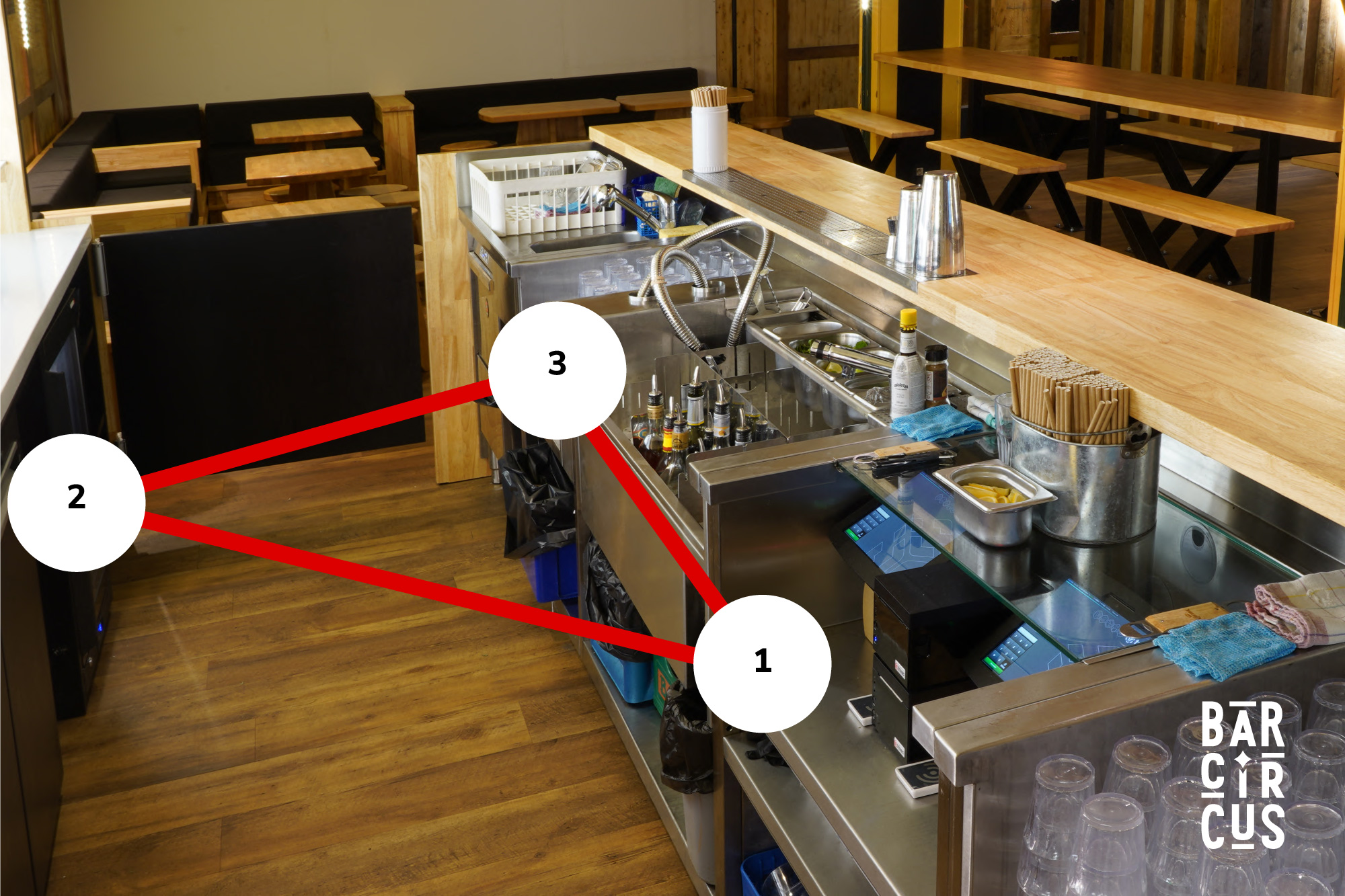
The core activity of a bar is located in the PRODUCTION area, where two other main activities are categorized into two major families: WASHING, STOCK. These three families all operate during the bar station service, each individually and most often in interaction. All other activity zones in macro activity help to converge the flow of products and materials to the production site, and then to either exit as finished goods or as waste.

Production:

Production should represent the bartender's main occupation. PRODUCTION in a professional bar involves all the interventions necessary for service delivery. This includes beer pouring, cocktail preparation, serving wine by the glass, and all other actions up to payment processing. Production equipment and tools consist of a wide variety of references and significantly involve the storage family.

The production area of the bar should be connected with the service area through either the customer counter for bar service or a dispatch area located at the bar. This allows service personnel to easily carry out orders.

Washing:

The "washing" area is the simplest to identify, as it involves a specific function with dedicated equipment. It is also called the dishwashing station. The flow of cleaned materials comes from the counter and returns from the dining area depending on the establishment's strategy, and is then sent to a STOCK station to be made available for production. Depending on the establishment, the washing area may be entirely relocated to an office due to space constraints, washing volume, or prestige considerations.

Stock:

We classify as storage all equipment, materials, and setups used to store products. This category includes refrigerators, shelves, glass storage areas, speed racks, ice bins, and other dedicated storage spaces.

The STOCK area is divided into two sub-zones. The first sub-zone is PRODUCTION STOCK, which is storage primarily allocated for production and located close to production for easy and immediate access. The second sub-zone is INDIRECT PRODUCTION STOCK. As the organization, size, and storage capacity of DIRECT STORAGE cannot efficiently meet service volume, INDIRECT STORAGE is placed more isolated or relocated. It serves as a buffer stock intended to replenish DIRECT STORAGE. For example, a remote cold room from a production refrigerator or an ice machine located in an office that is regularly emptied to supply the cocktail station at the bar.
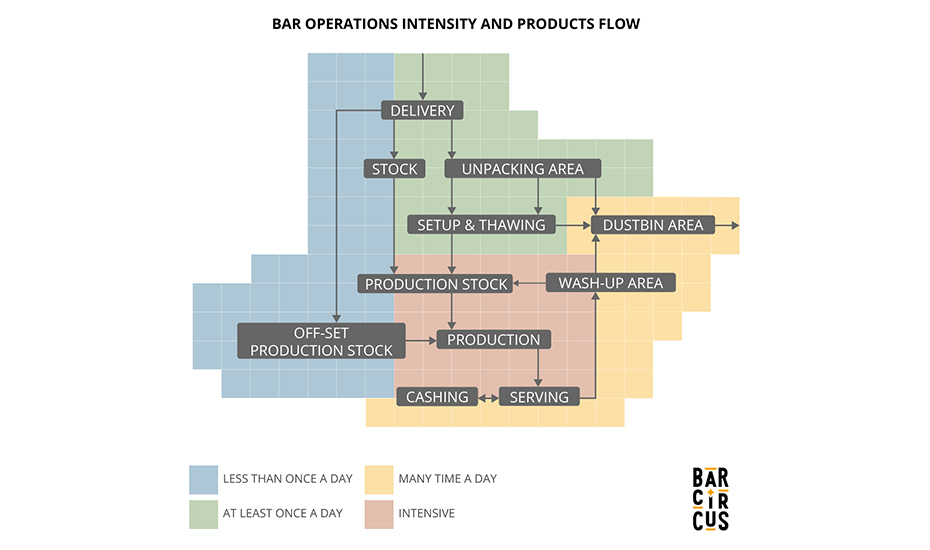
These three families are grouped under the term "production triangle" of the bar; it must be clear and efficient. Depending on the production map and volumes, it allows the staff to take as few steps as possible. To achieve this, it is preferable to refer to the compliance with ergonomic standards for bar stations.

To assist our partners and clients, we offer to advise them from the design to the production of the bar by developing and applying a precise bar project steps plan.

You may also be interested in these other tips