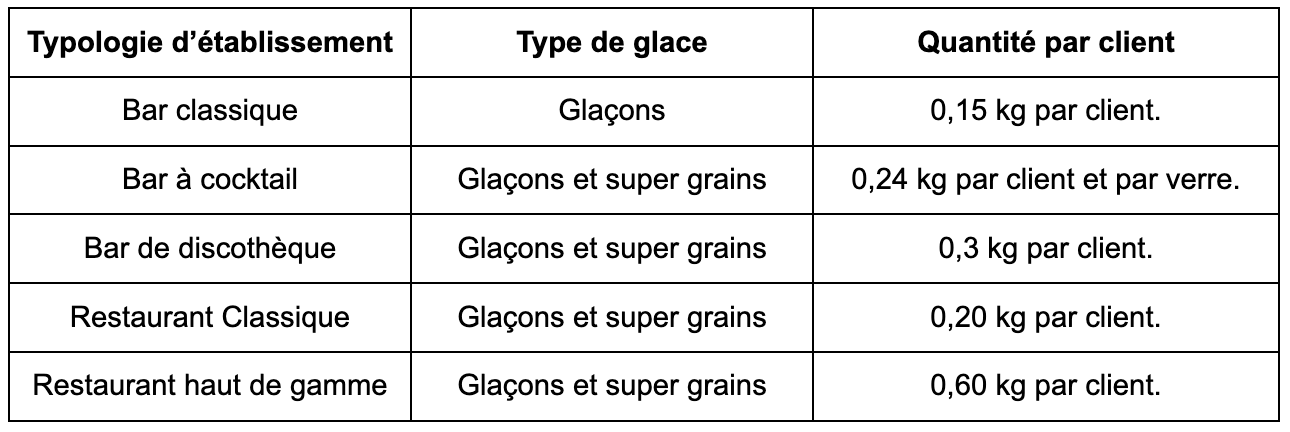
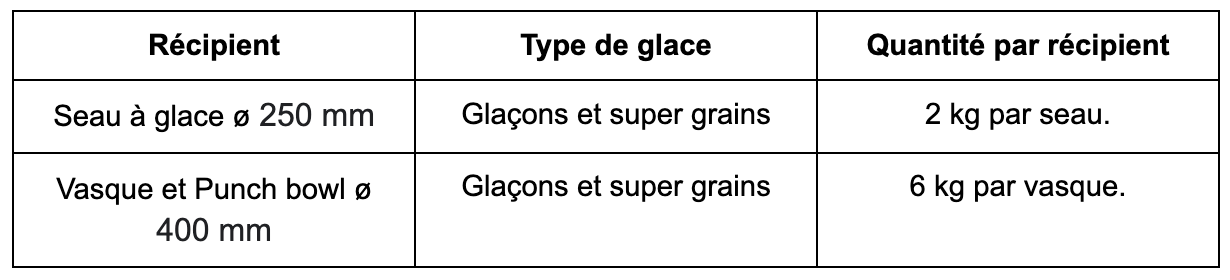
For example, a classic restaurant serves 40 customers and typically has 4 services per day. The calculation is 4x40x0.2 = 32 kg of ice needed per day. Knowing the outputs, we add ice buckets, for example, about ten of them, 10x2+32 = 52 kg of daily ice needs.
Calculation of ice consumption per glass for cocktail bars:
For a cocktail station, the ice calculation is based on the number of glasses:
- Long Drink: shaken and ice in the glass = 2.7 kg of ice cubes for 10 glasses.
- Short Drink: shaken and ice in the glass = 2.2 kg of ice cubes for 10 glasses.
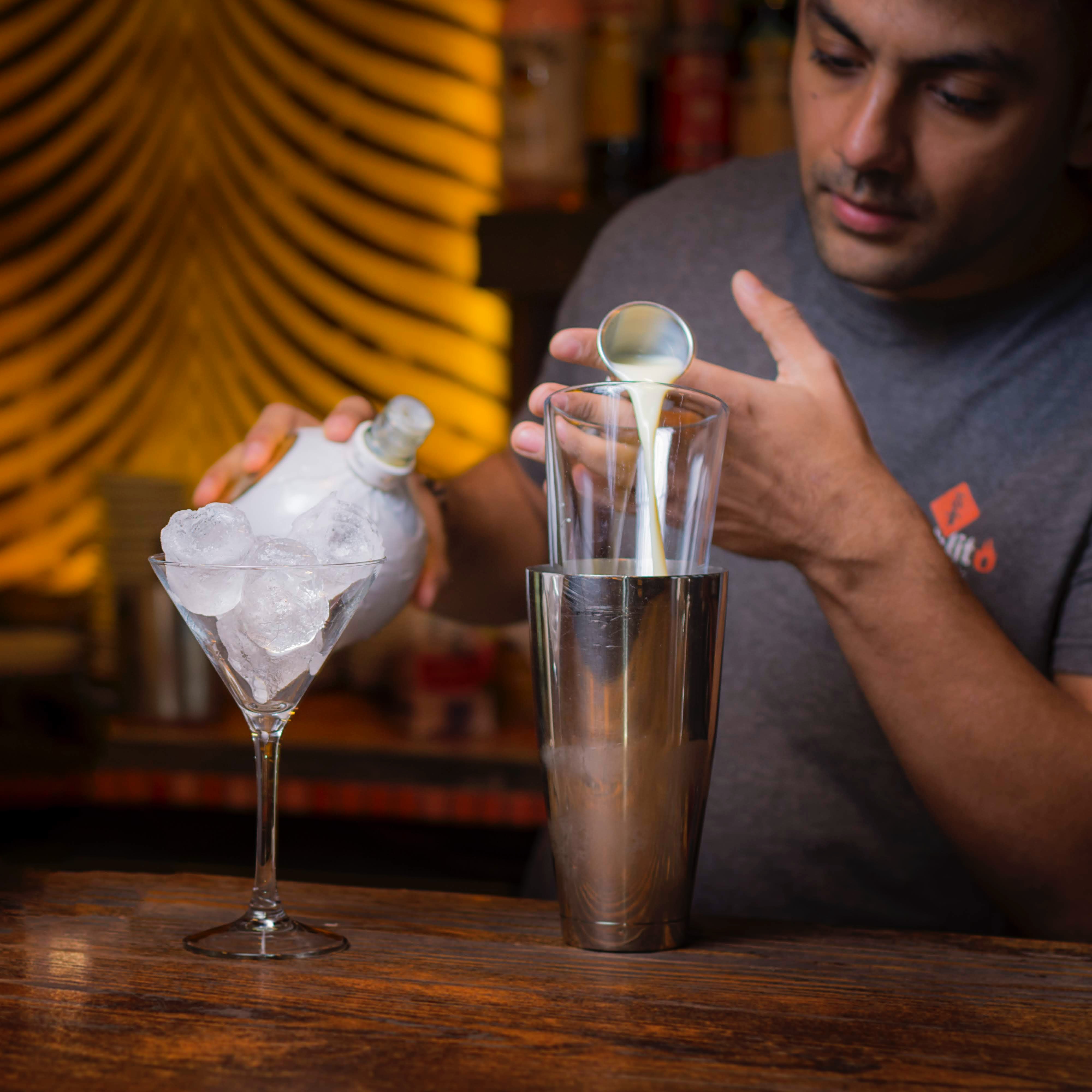
We estimate an average ice consumption per glass (CV) of 0.24 kg of ice cubes per glass served. The consumption is based on the optimal preparation of a quality cocktail using a shaker and a mixing glass with the preparation ice discarded after use.
Calculation to determine ice needs based on glass production is:
Number of cocktails produced for a service/CV = kg of ice needed for the service.
The information on daily ice consumption is insufficient to choose an ice machine.
Generally, ice machines don't have a storage bin as large as their advertised productivity. Indeed, the production is indicated for 24-hour production, but the bin often has a capacity lower than this value. This means that the ice machine stops production when it detects that the bin is full. Thus, the production speed is just as important as the storage bin capacity.
- SMG: ice stock available in kilograms in the ice machine's storage bin.
- SI: total ice storage in kg at the bar (ice wells or any other ice storage container in the production area).
- RSMG: remaining ice stock available in kilograms in the ice machine's storage bin after emptying it once into the production storage (SI).
- CPH: production capacity in kg per hour of the ice machine.
- CV = ice consumption in kg per glass.
The value of CV (consumption per glass) differs depending on the type of production. 0.24 kg of ice per glass is one of the highest values. Depending on the type of production, the values differ. For simple tall soda glasses from bistros or Collins-type nightclub glasses, the need is 0.15 kg of ice per glass.
We can thus easily calibrate the choice of an ice machine.
For example: A cocktail bar produces over 450 cocktails in one evening. So a need for ice of 450*0.24 = 108 kg of ice. Logically, one would opt for an ice machine capable of delivering 108 kg of ice over 6 hours of service by emptying the bin and counting the additional production during the 6 hours of service.
A first ice machine of 130 kg/24 h has a storage bin of 50 kg.
At setup at 6 pm, the bartenders can fully fill their two ice wells. A cocktail bar ice well has an average capacity of 60 kg of ice, and this bar has two. It is never entirely filled because accessories and bottles are often integrated into the ice well. At 6 pm, it thus empties the ice machine's storage bin. They will therefore consume the 50 kg in the ice wells in the first part of the evening, which is:
SMG or SI (depending on the smaller value) * CV ≈ the number of cocktails produced, or 50 / 0.24 ≈ about 208 cocktails.
But during the 6 hours between 6 pm and midnight, the ice machine will continue to produce 130/24*6 = 32.5 kg. So an additional cocktail capacity of:
32.5/0.24 ≈ 135 cocktails.
This results in a total cocktail capacity of 135 +208 = 343 cocktails per service, which is below the target of 450 cocktails.
If we move to the higher model of ice machine producing 240 kg for a storage bin of 110 kg, we get:
(110/0.24) + (240/24/6 / 0.24) ≈ 708 cocktails per service.
This second ice machine model is therefore well-sized for the bar and can easily meet the demand for 450 cocktails and more if needed.
Formula for calculating by cocktail bar service valid in most cases:
(SMG or SI [depending on the smaller value]/CV)
+
([RSMG + CPH * service duration in hours]/CV)
=
Cocktail capacity per service
The main components of ice machines. An ice machine is composed of:
- A refrigeration unit operating with air or water.
- An ice production compartment composed either of specific trays for ice cubes or a screw conveyor for flake ice.
- A storage bin collecting the ice production and insulated to keep the ice available in the bin for as long as possible.