advice

This section brings together all the best practices from design to execution of efficient stainless steel bar stations. As every establishment has its own specifics, we share our knowledge and industry experience as bar designers and builders to help you better understand your project.

CALIBRATION OF THE BAR PRODUCTION TOOL

- Categories : Best practices

After opening your establishment, nothing is more frustrating than realizing that the production tool, i.e., the bar layout and integrated equipment, is not suitable. Productivity may have been largely underestimated or overestimated in relation to customer demand, or certain functionalities might have been forgotten.

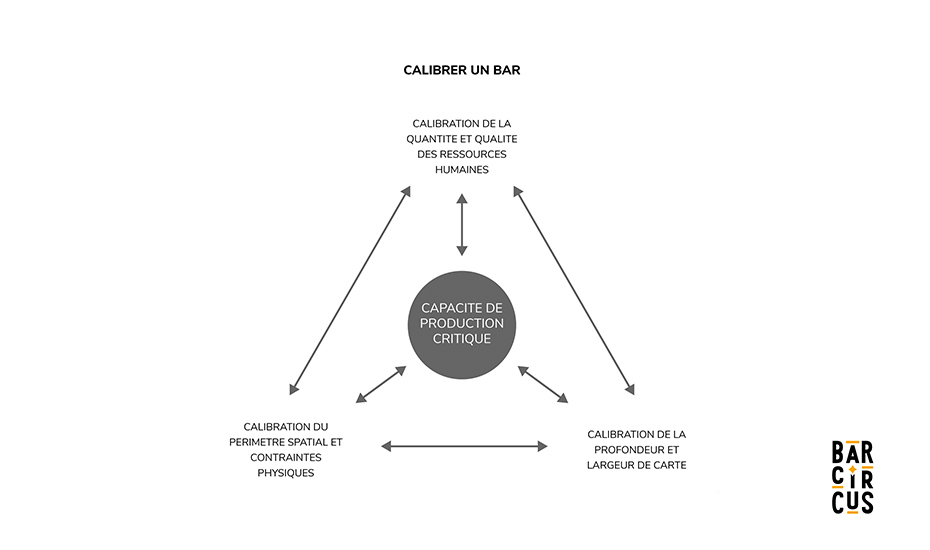
The calibration of the production tool of the bar station involves finding the right balance between human and material resources, in relation to a spatial footprint and a defined need for the menu to be delivered in a specific timeframe.

The main parameters sought are:

- Human resources in terms of number and skills.

- The spatial perimeter of the bar and remote stock.

- The diversity of the bar menu and the volumes.

The work rarely starts from a blank page. Often, experience provides us with a usual size of the bar station linear, or the history of the place offers us a large part of the information. Some data in a project may be inflexible, such as the available space of the bar station or the diversity of the menu offered. This allows for adjustments of other parameters. It is advisable to never forget the possible modifications of the bar's offerings over time, as well as seasonality or future transformations, in order to integrate them into the creation.

We are primarily looking for the critical production capacity, which is the largest volume generated in a limited time, representing the peak period at the bar. This research base allows us to meet the most demanding parameters to smoothly handle the rest of the bar's timeline.

Diagram on calibrating a bar

The comprehensive list of questions to ensure this calibration is outlined in the sections "Structuring the Programming" and "Basis of the Specifications".

Financial Rationalization

Previously, the key objective for calibrating a bar was its critical production capacity. However, the financial aspect is an additional and significant parameter to consider.

Budgets during the creation of a bar are crucial, but they should not overly hinder the project. Several options allow for adjusting the final price of a bar.

The quality of equipment:

Choosing alternatives to the most well-known brands can be a solution, provided that the quality of the selected product is known. Refrigerators have many alternatives. It's important to ensure the guarantees and feedback from other clients. Obviously, quality equipment related to the core offering of the establishment should be preserved. For example, a cocktail bar will prioritize a perfectly producing ice machine. This way, cost reductions can be significant while maintaining quality equipment where it is essential.

Equipment division:

To limit the risk of business interruption during a breakdown, instead of installing, for example, a four-door back bar refrigerator with a built-in unit, one can duplicate two-door bar refrigerators with built-in units. This way, in case of a breakdown, it is still possible to operate at 50% of the stock. This practice is common but increases costs. It's important to carefully weigh the pros and cons before deciding whether to divide the equipment.

Financing:

There are several types of financing:

Banks offer leasing options or specialized financing companies. This remains an interesting option although often the final cost increases by 8% to 15%. In return, it allows payments to be spread over several months or years. Be cautious, leasing is a solution that requires a history of balance sheets to assess recovery capabilities. Therefore, it is not the ideal solution when creating an establishment. In some cases, leasing companies base their decision on the previous activity of the location if the previous establishment's offering is similar.

Brewers offer equipment investments or loans in exchange for contracts with their goods. This solution is interesting for establishments not looking to stand out too much in their offering against competitors, as the proposals are made based on mainstream products.
Non-purchase:

While waiting to generate cash flow for investment, it may be feasible not to equip at 100% and to postpone certain purchases. For example, standard stainless steel bar stations can be easily transformed in the future, making it possible to add an extra cocktail station, additional shelves, or any options that were initially out of budget.

Second-hand:

We recommend the second-hand market very little for professional electrical equipment unless it has been serviced by a technician who can ensure its maintenance in your establishment and possibly provide you with a warranty.